

How DevOps and Support Teams Collaborate to Minimize IT Outages
How DevOps and Support Teams Collaborate to Minimize IT Outages
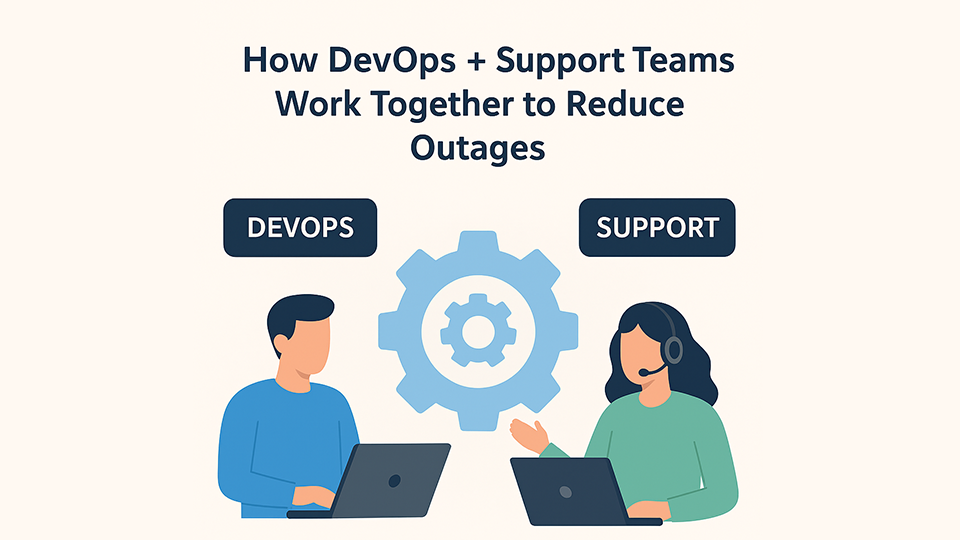
In today’s fast-paced digital environment, system downtime can cost companies millions and damage customer trust. To minimize outages and maintain high service reliability, DevOps and support teams need to work closely together. Here’s how this collaboration can be achieved effectively.
1. Shared Responsibility for System Reliability
Traditionally, support teams react to issues while DevOps teams handle deployment and infrastructure. By aligning goals, both teams share responsibility for uptime. DevOps engineers gain insight into recurring support issues, while support teams understand potential deployment risks, creating a proactive approach to system reliability.
2. Unified Monitoring and Alerts
Effective collaboration starts with shared visibility. DevOps teams implement monitoring tools and dashboards that support teams can access. Unified alerts ensure that both teams are aware of anomalies in real time, enabling faster detection, diagnosis, and resolution of potential outages.
3. Proactive Incident Management
Instead of waiting for users to report issues, combined DevOps-support workflows enable proactive incident handling. Playbooks and automated incident response systems allow support teams to escalate problems quickly, while DevOps teams implement long-term fixes to prevent recurrence.
4. Post-Mortem Analysis and Continuous Improvement
After an outage, joint post-mortem sessions help identify root causes and process gaps. By sharing lessons learned, both teams can improve monitoring rules, deployment practices, and response protocols, reducing the likelihood of future incidents.
5. Automation and Tool Integration
Automation is key to reducing human error and response time. By integrating ticketing systems, monitoring tools, and CI/CD pipelines, DevOps and support teams can streamline workflows, automatically trigger alerts, and implement fixes faster.
6. Knowledge Sharing and Communication
Regular knowledge-sharing sessions and open communication channels break down silos. Support teams provide feedback from end-users, while DevOps teams educate support staff on new deployments and system changes, creating a collaborative culture that prioritizes uptime.
Conclusion
When DevOps and support teams collaborate effectively, companies achieve faster incident resolution, fewer outages, and more reliable systems. By aligning responsibilities, integrating tools, and fostering communication, businesses can maintain uptime, improve customer satisfaction, and build a culture of continuous improvement.
Turn insights into action with Prodaxion’s expert application support and MSP solutions.
Turn insights into action with Prodaxion’s expert application support and MSP solutions.
Get reliable uptime, proactive monitoring, and performance-focused support tailored for modern businesses. Our specialists are ready to help you strengthen your systems and scale with confidence.