

Incident Management Best Practices for Application Support Teams
Incident Management Best Practices for Application Support Teams
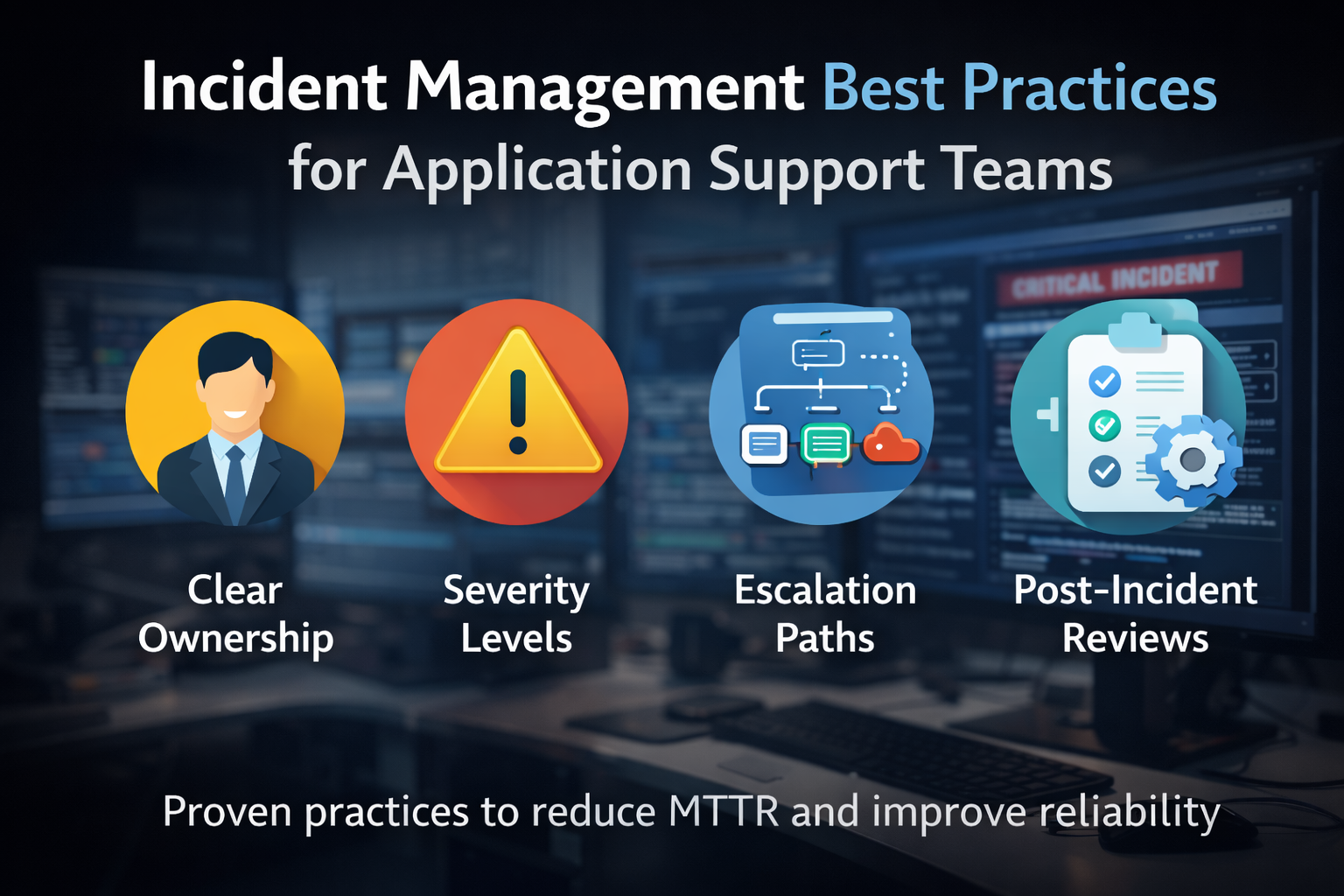
In today’s always-on digital environments, effective incident management is critical for application support teams. Slow or unstructured responses lead to extended downtime, missed SLAs, and frustrated users. By following proven incident management best practices, application support teams can respond faster, reduce MTTR, and maintain system reliability.
Define Clear Incident Ownership
Every incident must have a clearly defined owner from the moment it is identified. Clear ownership avoids confusion, reduces duplicated effort, and ensures accountability throughout the incident lifecycle. Application support teams with defined ownership models consistently resolve incidents faster.
Standardize Incident Severity Levels
Not all incidents require the same response. Defining clear severity levels helps teams prioritize work and allocate resources effectively. Severity classification should be consistent, easy to understand, and aligned with business impact to prevent over- or under-escalation.
Centralize Monitoring and Logging
Centralized monitoring and structured logging give application support teams real-time visibility into system behavior. When logs and alerts are accessible in one place, teams spend less time searching for information and more time resolving incidents. This directly contributes to lower MTTR.
Establish Clear Escalation Paths
Unclear escalation paths are a major cause of delays in incident resolution. Application support teams should document when and how incidents are escalated, including who to contact and expected response times. Clear escalation processes ensure faster collaboration during critical situations.
Communicate Clearly During Incidents
Consistent communication reduces uncertainty and prevents misinformation during incidents. Application support teams should define communication channels and update frequency in advance. Clear, timely updates help stakeholders stay informed and reduce unnecessary interruptions.
Automate Where It Adds Value
Automation can significantly improve incident response when applied thoughtfully. Automated alerts, error logging, and ticket creation reduce manual effort and speed up initial response. However, automation should support existing processes, not replace clear decision-making.
Conduct Post-Incident Reviews
Post-incident reviews are essential for long-term improvement. Instead of assigning blame, reviews should focus on identifying process gaps, recurring issues, and improvement opportunities. Over time, this practice reduces incident frequency and improves response quality.
Build a Repeatable Incident Response Process
Consistency is key to effective incident management. Documented and repeatable processes help application support teams respond calmly and predictably, even under pressure. Teams that follow consistent workflows see improved reliability and reduced downtime.
Final Thoughts
Strong incident management is built on clarity, consistency, and continuous improvement. By implementing these best practices, application support teams can reduce MTTR, improve system stability, and deliver a better experience for users and stakeholders. Tools play an important role, but well-designed processes remain the foundation of effective incident response.
Tags: incident management best practices,application support teams,incident response process,reduce MTTR,production support,IT incident management,application support best practices,incident escalation process,IT operations support,post-incident review
Turn insights into action with Prodaxion’s expert application support and MSP solutions.
Turn insights into action with Prodaxion’s expert application support and MSP solutions.
Get reliable uptime, proactive monitoring, and performance-focused support tailored for modern businesses. Our specialists are ready to help you strengthen your systems and scale with confidence.