

Why Most Production Incidents Escalate Because of Unclear Ownership
Why Most Production Incidents Escalate Because of Unclear Ownership
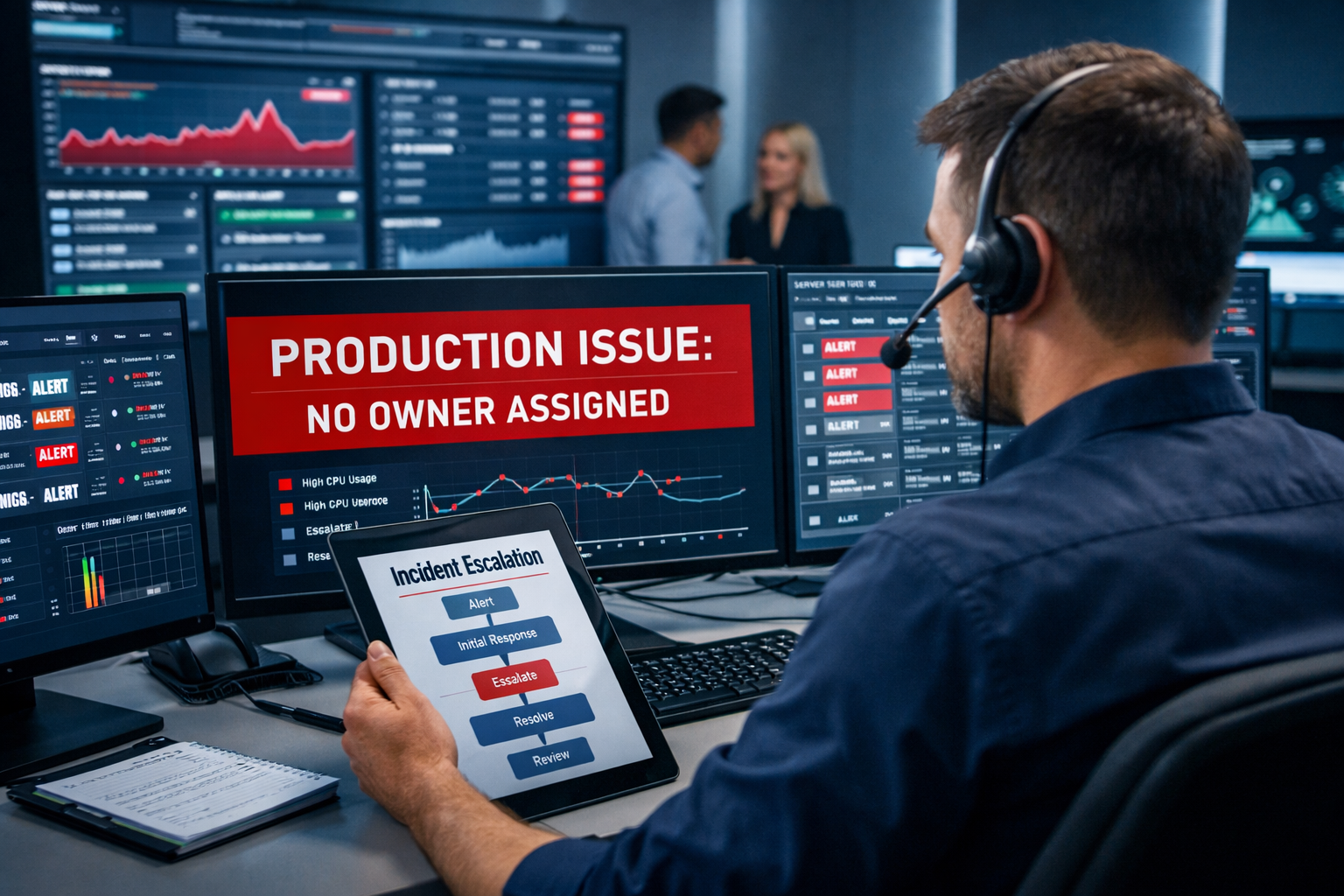
Production incidents are rarely caused by a lack of monitoring or tooling. Most organizations today have alerts, dashboards, and observability platforms in place. Yet incidents still escalate, outages last longer than expected, and MTTR remains high.
One of the most common—and overlooked—reasons for this is unclear ownership during incident response.
The Hidden Delay in Incident Response
When a production issue occurs, alerts are triggered and multiple teams are notified. Application support, infrastructure, DevOps, and sometimes business stakeholders all get involved. However, if no single owner is responsible for driving the incident to resolution, valuable time is lost.
Teams often spend the first critical minutes figuring out:
-
Who should take charge
-
Who is responsible for investigation
-
Who should communicate updates
-
When to escalate
This coordination delay causes small issues to escalate into major production incidents.
Why Alerts Alone Are Not Enough
Monitoring tools are designed to detect problems, not manage them. Alerts can tell teams that something is wrong, but they cannot decide who should act, what the priority is, or how escalation should happen.
Without a clearly defined incident owner:
-
Alerts lead to parallel investigations
-
Decisions are delayed
-
Accountability becomes unclear
-
Escalations happen too late
This is why organizations with advanced monitoring still struggle with production support efficiency.
The Role of Clear Incident Ownership
Clear ownership is one of the most effective ways to improve incident management. When a single person or team is accountable for an incident from detection to closure, response becomes structured and predictable.
Effective incident ownership includes:
-
Assigning a primary incident owner immediately
-
Giving the owner authority to coordinate teams
-
Ensuring clear escalation paths
-
Maintaining consistent communication
This approach significantly reduces MTTR and prevents unnecessary escalations.
Ownership Improves Communication and Confidence
During production incidents, stakeholders need timely and accurate updates. When ownership is unclear, communication often breaks down, leading to confusion and loss of trust.
A defined incident owner ensures:
-
One source of truth
-
Regular status updates
-
Faster decision-making
-
Better collaboration across teams
This not only improves resolution speed but also strengthens operational confidence.
Preventing Escalations Through Process
Unclear ownership is a process problem, not a people problem. Organizations that document incident roles, define severity levels, and practice response workflows experience fewer escalations and faster recovery.
Mature application support teams treat incident ownership as a core part of their production support process—not an afterthought.
Conclusion
Most production incidents escalate not because teams lack tools, but because they lack clarity. Alerts and dashboards are essential, but clear incident ownership is what turns visibility into action.
By defining ownership early, establishing clear escalation paths, and reinforcing structured incident management processes, organizations can reduce downtime, improve MTTR, and build more resilient production systems.
#IncidentManagement #ProductionSupport #ITOperations #ApplicationSupport #MTTR #DevOps
Turn insights into action with Prodaxion’s expert application support and MSP solutions.
Turn insights into action with Prodaxion’s expert application support and MSP solutions.
Get reliable uptime, proactive monitoring, and performance-focused support tailored for modern businesses. Our specialists are ready to help you strengthen your systems and scale with confidence.