

Why On-Call Rotations Break Down as Companies Scale
Why On-Call Rotations Break Down as Companies Scale
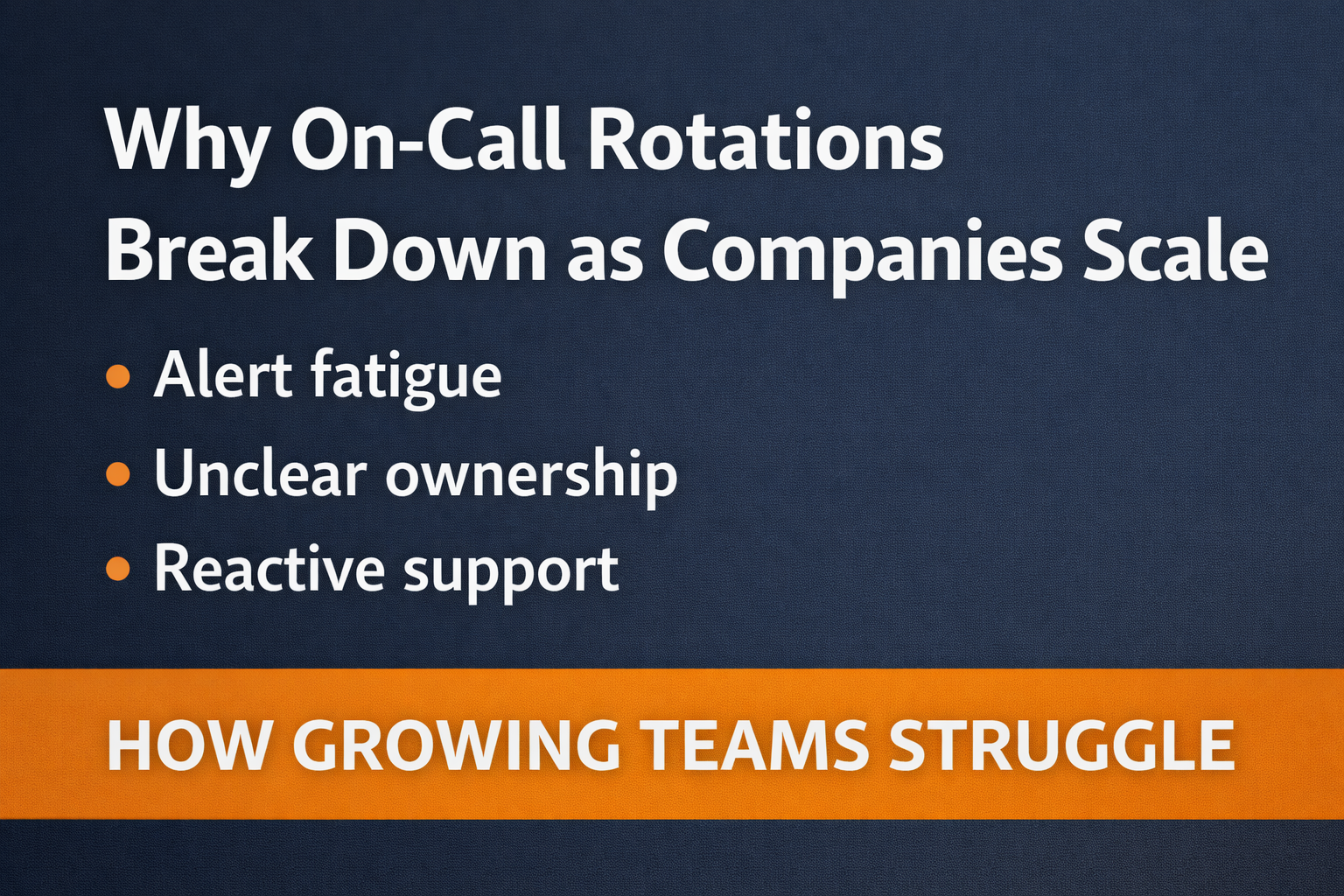
On-call rotations are essential for maintaining reliable application support and production stability. Yet, as companies grow, many discover that their once-functional on-call model starts to fail. Incidents escalate more often, response times increase, and engineers experience burnout.
This breakdown isn’t caused by a lack of talent or commitment. It’s a result of scaling without evolving the incident response process, ownership model, and support structure.
On-Call Works at Small Scale — Until It Doesn’t
In early-stage teams, on-call rotations are often informal but effective. Everyone understands the system, the codebase is smaller, and communication happens naturally.
As organizations scale:
-
Systems become more complex
-
Teams specialize
-
Dependencies increase
-
Incident volume grows
Without process maturity, on-call becomes reactive instead of reliable.
The Real Reasons On-Call Rotations Fail
1. Unclear Ownership Across Services
As more applications, microservices, and integrations are added, ownership often becomes blurred. When an alert fires, teams waste time determining who owns the issue, delaying resolution and increasing downtime.
Clear service ownership is foundational to effective incident management.
2. Outdated or Missing Documentation
Scaling teams often rely on tribal knowledge. When senior engineers aren’t available during incidents, responders struggle due to:
-
Missing runbooks
-
Incomplete escalation steps
-
Undocumented dependencies
This leads to longer MTTR and unnecessary escalations.
3. Alerts Increase, Signal Quality Decreases
As systems scale, monitoring tools generate more alerts — but not better ones. Poor alert hygiene causes:
-
Alert fatigue
-
Ignored notifications
-
Delayed responses
On-call engineers spend more time filtering noise than fixing issues.
4. On-Call Is Added, Not Designed
Many companies add people to the on-call rotation without redesigning the model. The result:
-
Unbalanced workloads
-
Frequent context switching
-
No clear backup or escalation paths
On-call becomes unsustainable instead of scalable.
5. No Feedback Loop After Incidents
Without structured post-incident reviews and root cause analysis, the same problems repeat. Scaling teams need process improvement, not just faster firefighting.
What Scalable On-Call Models Do Differently
High-performing teams redesign on-call as part of their growth strategy. They focus on:
-
Defined ownership for every production service
-
Clear escalation paths and on-call responsibilities
-
Well-maintained runbooks and incident workflows
-
Meaningful alerts tied to business impact
-
Regular incident reviews that drive system improvements
This transforms on-call from a burden into a predictable support function.
Why Process Matters More Than Tools
Modern monitoring and alerting tools are powerful, but they can’t fix broken processes. Without clear accountability and structured incident response, even the best tools fail to reduce downtime.
Scalable on-call success depends on operational discipline, not heroics.
How Growing Companies Can Fix On-Call Before It Breaks
Organizations that invest early in:
-
Incident management frameworks
-
Application support models aligned with business growth
-
Sustainable on-call rotations
experience lower MTTR, better system reliability, and healthier engineering teams.
Final Thoughts
On-call rotations don’t break because companies grow.
They break because process maturity doesn’t grow with the company.
Designing scalable incident response and application support isn’t optional anymore — it’s a competitive advantage.
If your on-call rotation feels increasingly fragile as your systems scale, it may be time to rethink the process behind it.
👉 Learn how Prodaxion Technologies helps growing businesses design scalable production support and incident management models at https://www.prodaxion.com
on call rotations,incident management,application support,production support,scalable on call models,incident response process,reduce mttr,alert fatigue,engineering on call,devops support,site reliability practices,production incidents,operational discipline,it support best practices,growing tech companies
Turn insights into action with Prodaxion’s expert application support and MSP solutions.
Turn insights into action with Prodaxion’s expert application support and MSP solutions.
Get reliable uptime, proactive monitoring, and performance-focused support tailored for modern businesses. Our specialists are ready to help you strengthen your systems and scale with confidence.