

How Log Analysis Helped One Startup Reduce Cloud Bills by 35%
How Log Analysis Helped One Startup Reduce Cloud Bills by 35%
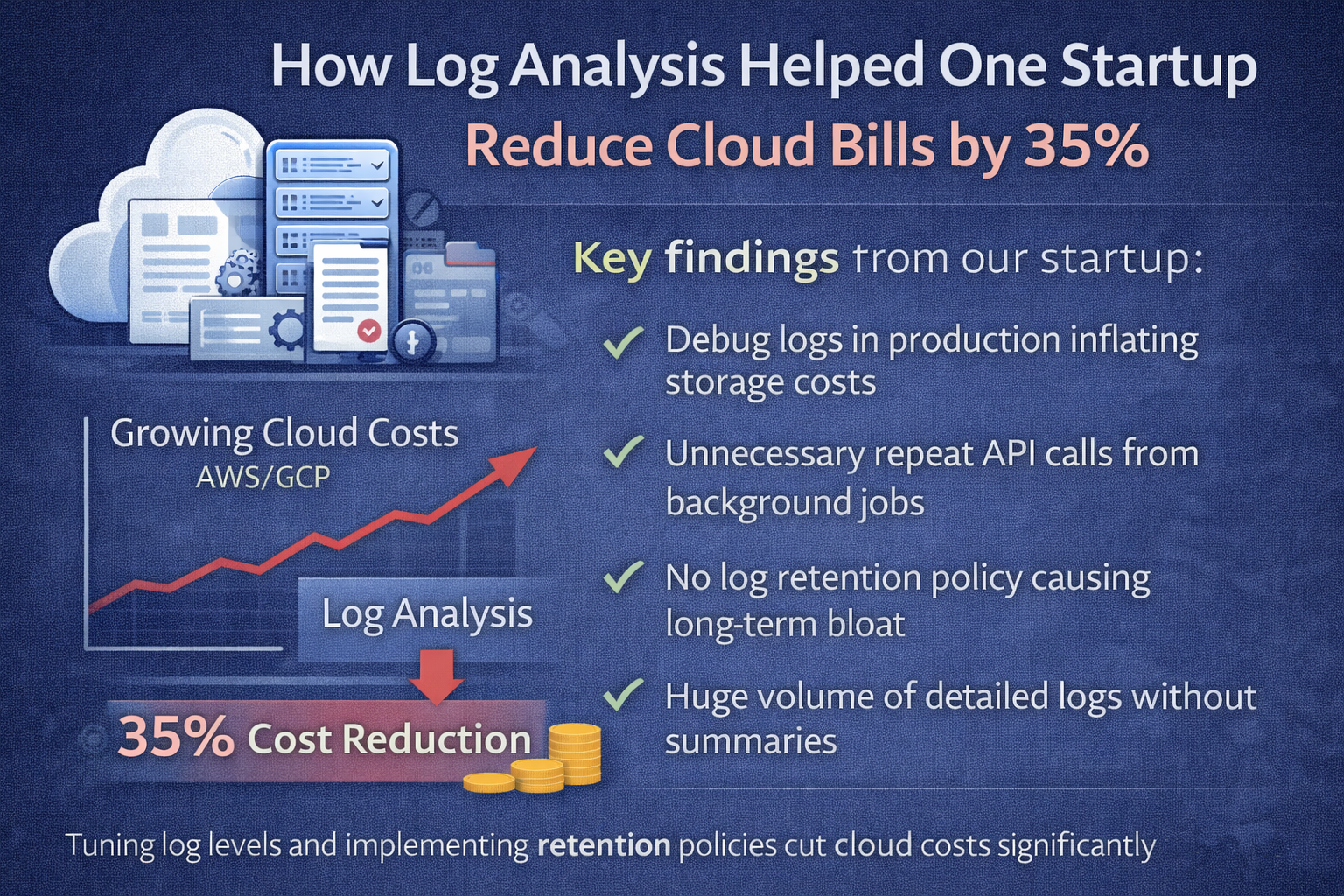
Cloud costs are one of the fastest-growing expenses for modern startups. As products scale, infrastructure usage increases, logs multiply, and observability tools quietly add to monthly bills.
But for one SaaS startup, the biggest cost leak wasn’t compute, storage, or networking—it was logging.
By performing structured log analysis and optimization, the company reduced its cloud bill by 35% in just 60 days—without sacrificing performance or reliability.
Here’s how they did it.
The Hidden Cost of Logs in Cloud Environments
Most engineering teams treat logs as a technical necessity, not a financial variable. But in cloud environments, logs generate costs in multiple ways:
-
Log ingestion fees (e.g., CloudWatch, Datadog, Splunk, ELK)
-
Storage costs for retained logs
-
Indexing and query charges
-
Network transfer costs from distributed services
As applications scale, logs can become one of the largest invisible cloud expenses.
The Problem: Rising Cloud Bills Without Scaling Users
The startup noticed a recurring issue:
-
Monthly cloud bills increasing by 10–15%
-
No equivalent increase in users or traffic
-
No major infrastructure changes
Initial assumptions pointed to inefficient compute usage. But deeper investigation showed that log volume was growing exponentially.
So the team started with a structured log analysis and cost audit.
Step 1: Identifying Excessive Log Volume
The first discovery was excessive logging levels in production:
-
Debug-level logs enabled in live environments
-
High-frequency logs from background jobs
-
Repetitive logs from retry mechanisms
Some microservices were producing thousands of logs per second, many of which were never used.
Action Taken:
-
Reduced log levels from DEBUG to INFO/WARN
-
Disabled verbose logging in stable components
-
Introduced conditional logging for troubleshooting only
Step 2: Fixing Misconfigured Retries and Duplicate Requests
Log analysis revealed a more serious issue:
misconfigured retry logic that triggered duplicate API calls.
These retries caused:
-
Extra compute usage
-
Increased outbound API costs
-
Massive log duplication
Action Taken:
-
Implemented exponential backoff for retries
-
Added circuit breakers and rate limiting
-
Reduced redundant logging for retries
Step 3: Implementing Log Retention Policies
Another major cost driver was infinite log retention.
The startup was storing all logs indefinitely—across multiple environments.
Action Taken:
-
Defined retention policies by environment
-
Production: 30–90 days
-
Staging: 14–30 days
-
Development: 7 days
-
-
Archived critical logs to low-cost cold storage
-
Deleted unnecessary historical logs
Step 4: Logging Smarter, Not More
Many services were logging full request/response payloads, including:
-
JSON objects
-
User metadata
-
Large transaction payloads
This dramatically increased storage and ingestion costs.
Action Taken:
-
Logged summaries instead of full payloads
-
Masked sensitive data
-
Structured logs with key fields instead of raw dumps
The Results: 35% Cloud Cost Reduction
After implementing log optimization:
-
Cloud observability costs dropped significantly
-
Overall cloud bill reduced by ~35% in 2 months
-
Performance improved due to reduced I/O overhead
-
Incident debugging became faster with cleaner logs
Most importantly, the startup gained predictable and controlled cloud spending.
Why Log Analysis Is a FinOps Strategy (Not Just DevOps)
Logs are not just technical artifacts—they are financial signals.
Analyzing logs helps organizations:
-
Detect inefficient services
-
Identify runaway processes
-
Optimize observability tooling costs
-
Improve performance and reliability
-
Support FinOps and cost governance initiatives
In modern SaaS businesses, log analysis is part of cloud cost optimization strategy.
Best Practices for Log Cost Optimization
To avoid runaway cloud bills, startups should:
-
Use structured logging with severity levels
-
Avoid debug logging in production
-
Implement log retention policies
-
Monitor log ingestion volume
-
Audit observability tools regularly
-
Align DevOps and FinOps teams on logging strategy
Final Thoughts
Cloud cost optimization doesn’t always require complex infrastructure changes. Sometimes, the biggest savings come from small operational discipline improvements—like logging smarter.
For startups and growing companies, log analysis is one of the fastest and most overlooked ways to reduce cloud costs while improving system reliability.
If you want to identify hidden cloud cost drivers and optimize your production support processes, Prodaxion Technologies can help.
Learn more about our managed support and cloud optimization services at: www.prodaxion.com
Tags: log analysis,cloud cost optimization,reduce cloud costs,startup cloud costs,aws cost management,gcp cost optimization,cloud observability,devops cost control,application logs,cloud monitoring,saas infrastructure costs,finops practices,log retention policy,cloud efficiency,prodaxion technologies
Turn insights into action with Prodaxion’s expert application support and MSP solutions.
Turn insights into action with Prodaxion’s expert application support and MSP solutions.
Get reliable uptime, proactive monitoring, and performance-focused support tailored for modern businesses. Our specialists are ready to help you strengthen your systems and scale with confidence.