

Application Support Company vs Managed Service Provider: What’s the Difference?
Application Support Company vs Managed Service Provider: What’s the Difference?
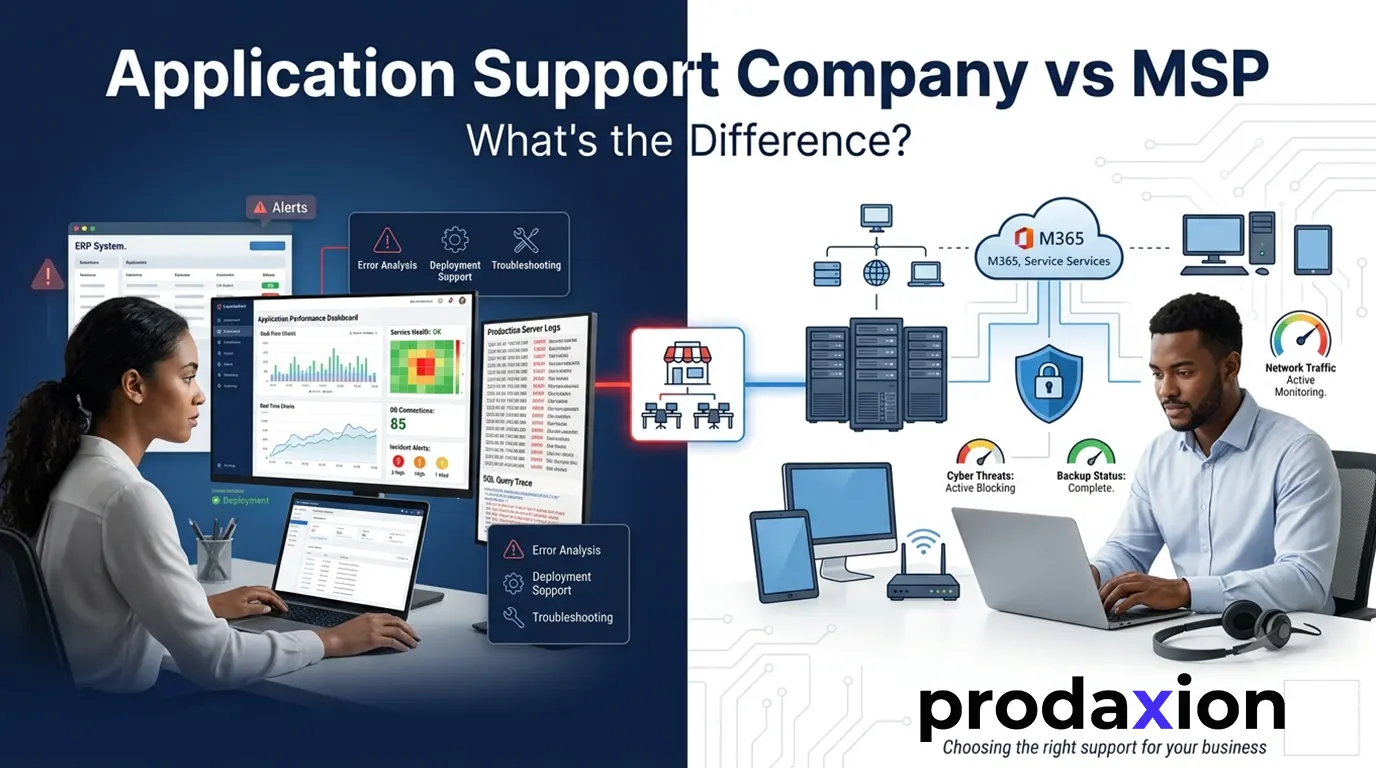
When a small or medium-sized business depends on software to run its daily operations, reliable technical support becomes increasingly important.
But when something goes wrong, what type of company should you call?
Should you work with a Managed Service Provider (MSP), or should you hire an application support company?
The two services can overlap, but they are not necessarily the same.
Understanding the difference can help business owners choose the right support model without paying for services they don’t actually need.
What Is an Application Support Company?
An application support company specializes in supporting the software applications that a business relies on.
The focus is generally on keeping business applications available, reliable, functional, and performing properly.
Depending on the provider, application support can include:
~ Production incident management
~ Application troubleshooting
~ Error and log analysis
~ Application monitoring
~ Performance troubleshooting
~ Deployment support
~ Database troubleshooting
~ Configuration issues
~ Root-cause analysis
~ Bug investigation
~ Incident escalation
~ Application availability monitoring
~ Operational support
For example, imagine a company operates an online ordering platform.
The website is accessible, but customers suddenly cannot complete their orders.
An application support team may investigate:
~ Application logs
~ API failures
~ Database errors
~ Recent deployments
~ Application configuration
~ Infrastructure dependencies
~ Performance problems
The objective is to identify the problem, restore service, and help prevent the same issue from happening again.
What Is a Managed Service Provider?
A Managed Service Provider (MSP) generally provides broader IT management services.
Rather than focusing primarily on one business application, an MSP may manage several parts of an organization’s IT environment.
Typical MSP services can include:
~ IT help desk
~ Desktop and laptop support
~ Microsoft 365
~ Email support
~ Network management
~ Wi-Fi
~ Servers
~ Backups
~ Cybersecurity
~ Cloud infrastructure
~ Endpoint management
~ IT infrastructure monitoring
An MSP can therefore be a good option for a business that needs overall IT management.
For example, a small company might use an MSP to manage:
- Employee computers
- Microsoft 365 accounts
- Network connectivity
- Backups
- Security software
- Printers
- Cloud infrastructure
The MSP becomes the company’s broader IT support partner.
Application Support vs MSP: The Main Difference
The easiest way to understand the difference is to look at what each provider is primarily responsible for.
| Application Support Company | Managed Service Provider |
|---|---|
| Focuses on business applications | Focuses on broader IT |
| Production application support | IT infrastructure support |
| Application incidents | Help desk and IT incidents |
| Application logs and errors | Networks, endpoints and servers |
| Application performance | Infrastructure performance |
| Deployment support | Infrastructure/cloud management |
| Root-cause analysis | General IT troubleshooting |
| Application availability | Overall IT availability |
There can certainly be overlap.
Some MSPs provide application support, while some application support companies also provide infrastructure services.
The important question isn’t simply what the company calls itself.
The important question is:
What type of support does your business actually need?
When Does a Business Need Application Support?
Many businesses reach a point where their software becomes too important to leave unsupported.
This can happen even when the company is relatively small.
For example, a business might rely on:
~ An e-commerce application
~ A SaaS platform
~ A customer portal
~ An online booking system
~ A financial application
~ A CRM
~ An ERP system
~ A custom-built business application
~ A logistics platform
~ An internal workflow application
If the application stops working, the business can immediately lose productivity or revenue.
In these situations, general IT support may not be enough.
A computer technician might be able to confirm that the employee’s laptop is working properly.
But that doesn’t necessarily answer:
Why is the application returning a 500 error?
Why did the latest deployment fail?
Why is the database connection timing out?
Why has application response time increased?
Why are customers unable to complete transactions?
These are application support problems.
When Is an MSP the Better Choice?
An MSP may be a better fit when the business needs broader IT support.
For example, if you need someone to manage:
~ Employee computers
~ Microsoft 365
~ Password and account issues
~ Network connectivity
~ Wi-Fi
~ Backup systems
~ Cybersecurity tools
~ Printers and peripherals
~ Servers
~ General IT infrastructure
then a traditional MSP may be appropriate.
For businesses without internal IT staff, having one provider responsible for the broader IT environment can be extremely valuable.
What If a Business Needs Both?
Many businesses eventually need both types of support.
Consider a small SaaS company.
It may need an MSP to manage:
~ Employee laptops
~ Microsoft 365
~ Network security
~ Endpoint protection
At the same time, it may need specialized application support for:
~ Production incidents
~ Application monitoring
~ AWS issues
~ Database problems
~ Deployment failures
~ Application performance
~ Customer-facing outages
These are different responsibilities.
The company may therefore use an MSP for general IT and an application support provider for its production application.
Why General IT Support Doesn’t Always Solve Application Problems
One of the biggest misconceptions among small businesses is that IT support and application support are the same thing.
They aren’t.
Suppose an employee says:
“Our application isn’t working.”
A general IT support provider might check:
- Is the computer connected to the internet?
- Is the browser working?
- Can the employee access other websites?
- Is the user’s account active?
Those checks are important.
But suppose the problem is actually caused by:
- A failed API
- A database connection problem
- An application deployment
- A software configuration change
- A memory leak
- A backend service failure
- A cloud resource problem
- An application code issue
That requires a different level of technical investigation.
This is where application support services can add value.
What Does Production Application Support Involve?
Production support is particularly important for businesses whose applications are actively used by customers or employees.
A production support team may be responsible for monitoring and responding to issues such as:
Application outages
The application becomes completely unavailable.
Performance degradation
The application is technically available but becomes extremely slow.
Application errors
Users encounter errors when performing specific actions.
Database problems
The application cannot access or properly process database information.
Deployment problems
A new release causes unexpected issues.
Integration failures
An API or third-party service stops communicating correctly.
Infrastructure dependencies
An application is affected by problems with cloud resources, servers, storage, networking, or other dependencies.
The goal isn’t simply to fix individual incidents.
A strong application support process should also look for patterns and recurring problems.
Why Root-Cause Analysis Matters
Fixing an incident is important.
Understanding why the incident happened can be even more important.
Imagine an application crashes once every two weeks.
A reactive support team might restart the application each time.
That restores service temporarily.
But if the underlying problem isn’t investigated, the same incident can continue happening.
A more structured application support approach may involve:
~ Reviewing logs
~ Identifying patterns
~ Examining recent changes
~ Investigating infrastructure dependencies
~ Identifying the root cause
~ Documenting the incident
~ Implementing corrective actions
This can help reduce recurring incidents and improve overall application reliability.
Application Support Doesn’t Have to Mean Hiring a Large Internal Team
For a small business, hiring a dedicated application support team can be expensive.
You may need:
~ Application support engineers
~ Cloud engineers
~ Database specialists
~ DevOps engineers
~ Monitoring specialists
~ Incident managers
A small business may not have enough workload to justify hiring all these roles full-time.
Outsourcing application support can provide access to technical expertise without requiring the business to build a large internal team.
This is one reason managed application support services can be attractive to growing businesses.
How Prodaxion Fits In
Prodaxion Technologies focuses on application and production support for businesses that need reliable technical assistance without necessarily building a large internal support organization.
Our focus is on the applications and production systems businesses depend on.
This can include areas such as:
~ Application monitoring
~ Production support
~ Incident management
~ Error and log analysis
~ Deployment support
~ Troubleshooting
~ Performance issues
~ Root-cause analysis
~ Operational support
The goal is not to sell businesses a large collection of IT services they may not need.
Instead, the focus is on providing practical application support for the systems that are important to the business.
Application Support for Small and Medium-Sized Businesses
Large enterprises often have dedicated application support, DevOps, infrastructure, and reliability engineering teams.
Small businesses usually don’t have the same resources.
A growing SMB might have:
One developer
or
A small development team
who originally built the application.
As the business grows, that development team may become responsible for:
~ New features
~ Bug fixes
~ Customer requests
~ Production incidents
~ Deployments
~ Monitoring
~ Infrastructure
~ Database issues
Eventually, something has to change.
Developers spending significant amounts of time dealing with production incidents means they have less time to develop the product.
Application support can provide a layer between development and day-to-day production operations.
Application Support vs MSP: Questions to Ask
Before choosing a provider, ask yourself the following questions.
1. What exactly needs support?
Is the problem your:
- Computers?
- Network?
- Microsoft 365?
- Cybersecurity?
- Servers?
- Business application?
2. What happens when your application goes down?
Do you have someone who can investigate the issue?
3. Who monitors your production environment?
Is someone actively watching application health and important alerts?
4. Who handles application incidents?
Do developers have to stop their work every time there’s a production problem?
5. Do you need 24/7 support?
Some applications can wait until the next business day.
Others cannot.
6. Do you need general IT or application expertise?
This is perhaps the most important question.
If your main problem is employee laptops and Microsoft 365, an MSP may be the right choice.
If your main problem is a customer-facing application, production incidents, deployments, and application reliability, specialized application support may be more appropriate.
Can an MSP Provide Application Support?
Yes.
Some MSPs provide application support in addition to their traditional IT services.
The important thing is to understand what is actually included in the service.
Ask the provider:
- Do you support production applications?
- Do you investigate application errors?
- Do you analyze logs?
- Do you support deployments?
- Do you troubleshoot databases?
- Do you work with cloud environments?
- Do you provide incident management?
- Do you provide root-cause analysis?
- Do you have application support engineers?
Don’t assume that an MSP’s general IT support package automatically includes specialized application support.
The Right Choice Depends on Your Business
There isn’t a universal winner between an application support company and an MSP.
The right choice depends on your business.
Choose an MSP when:
You need broad IT management covering employees, devices, networks, Microsoft 365, cybersecurity, servers, backups, and infrastructure.
Consider application support when:
Your business depends heavily on a software application and you need specialized assistance with production incidents, application performance, monitoring, deployments, logs, databases, and reliability.
Consider both when:
You need comprehensive IT management and specialized support for critical business applications.
Frequently Asked Questions
Is an application support company the same as an MSP?
No. There can be overlap, but an application support company generally focuses on business applications and production systems, while an MSP typically provides broader IT management services.
Does an MSP provide application support?
Some do. However, the scope varies considerably between providers. Businesses should confirm exactly what application support services are included.
What is application support?
Application support involves maintaining, monitoring, troubleshooting, and supporting software applications used by a business. It can include incident management, log analysis, performance troubleshooting, deployment support, and root-cause analysis.
Why would an SMB outsource application support?
Outsourcing can give a small business access to technical expertise without the cost of building a large internal application support team.
Does application support replace developers?
Usually, no. Application support and development have different purposes. Support focuses on keeping production systems operating reliably, while developers generally focus on building and improving the product. The two teams can work together.
Final Thoughts
The distinction between an application support company and a Managed Service Provider ultimately comes down to the type of problem you need solved.
An MSP can provide broad IT management across your organization.
An application support company focuses more deeply on the software and production systems your business relies on.
For an SMB whose biggest technology risk is a critical business application going down, specialized application support may be worth considering—even if the company already has general IT support.
At Prodaxion Technologies, we help businesses get practical application and production support without necessarily having to build a large internal support organization.
Learn More About Prodaxion’s Application Support Services
Your IT doesn’t have to be complicated. Your support model should simply match what your business actually needs.
Tags: application support company vs MSP,application support company,managed service provider,MSP vs application support,application support services,managed IT services,application support provider,production application support,application support for small business,SMB application support,IT support for small business,managed services for small business,production support services,application monitoring services,application incident management,incident management services,application troubleshooting,production incident support,log analysis services,application performance monitoring,application deployment support,root cause analysis services,outsourced application support,managed application support,application support outsourcing,IT managed services Canada,MSP services Canada,small business IT support,Prodaxion Technologies
Turn insights into action with Prodaxion’s expert application support and MSP solutions.
Turn insights into action with Prodaxion’s expert application support and MSP solutions.
Get reliable uptime, proactive monitoring, and performance-focused support tailored for modern businesses. Our specialists are ready to help you strengthen your systems and scale with confidence.