

Checklist for Transitioning from In-House Support to an MSP
Checklist for Transitioning from In-House Support to an MSP
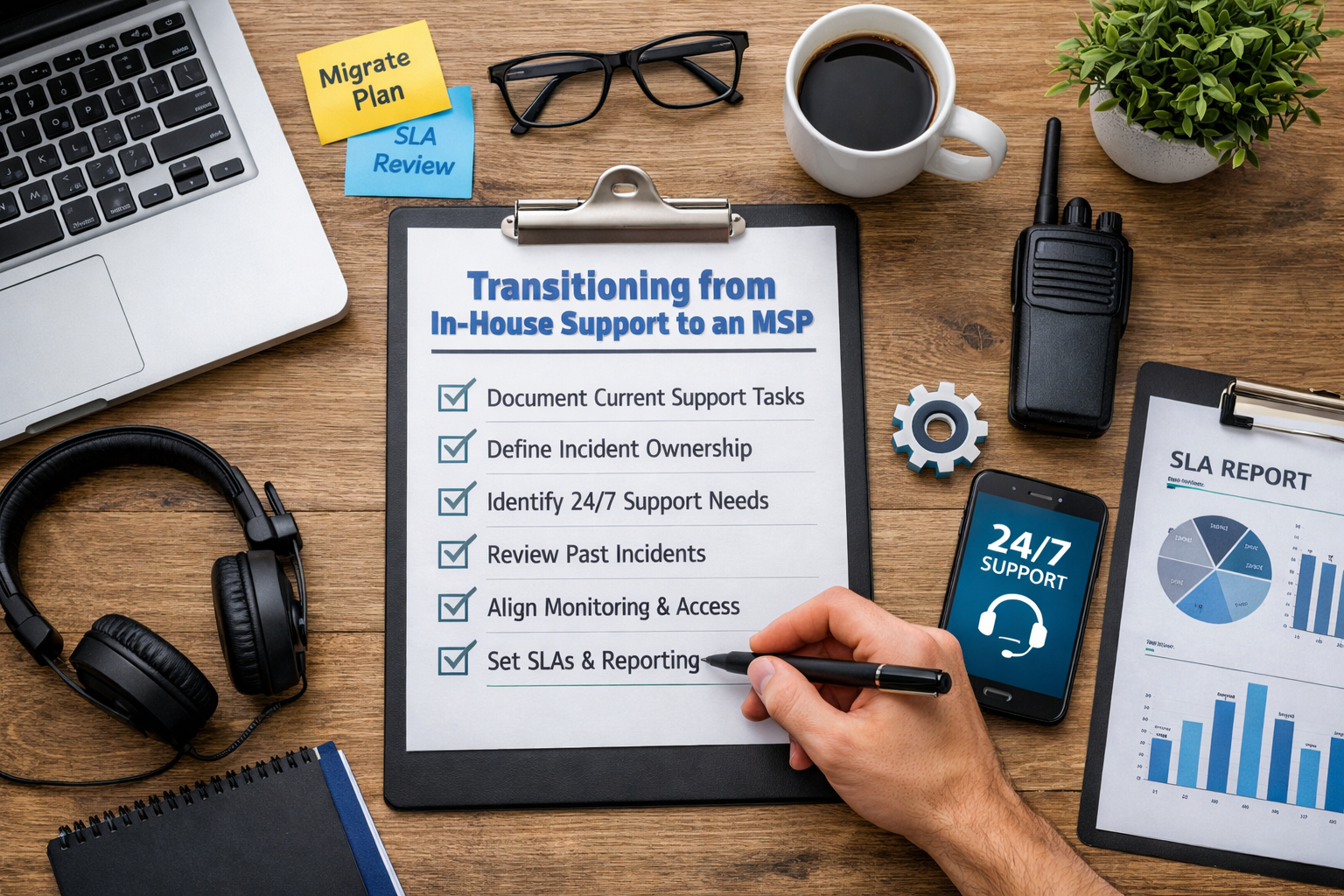
As businesses grow, many reach a point where in-house IT support struggles to keep up with increasing system complexity, extended support hours, and rising operational demands. What once worked for a small team can quickly turn into delayed responses, higher downtime, and burnt-out engineers.
This is where transitioning to a Managed Service Provider (MSP) becomes a strategic decision rather than a cost-cutting move. However, moving from in-house support to an MSP requires careful planning to avoid service disruptions and knowledge gaps.
This checklist outlines the key steps businesses should follow to ensure a smooth and successful transition.
1. Document Current Application and Production Support Responsibilities
Before engaging an MSP, it’s critical to clearly document how application support and production support are currently handled. This includes daily tasks, on-call duties, escalation paths, and known system dependencies.
Clear documentation helps the MSP understand your environment and prevents confusion during incident response.
2. Define Incident Ownership and Escalation Paths
One of the most common causes of failed MSP transitions is unclear ownership. Businesses must define:
-
Who owns incidents end-to-end
-
When issues are escalated
-
How communication flows during production incidents
Strong incident management processes ensure accountability and faster resolution, regardless of who is providing support.
3. Identify Systems That Require 24/7 Application Support
Not every system needs round-the-clock coverage. Identify which applications are business-critical and require 24/7 application support, and which can be handled during business hours.
This helps optimize support costs while maintaining reliability where it matters most.
4. Review Historical Incidents and Recurring Issues
Before the handover, review past incidents, outages, and recurring problems. Sharing this information with your MSP helps them:
-
Understand common failure points
-
Reduce repeat incidents
-
Improve MTTR (Mean Time to Resolution) from day one
Historical context is essential for effective production support.
5. Align on Monitoring, Alerts, and Access Controls
Ensure there is clear alignment on:
-
Monitoring tools and alert thresholds
-
System access and permissions
-
Security and compliance requirements
While tools are important, they must support well-defined processes. Clear access and alerting rules prevent delays during critical incidents.
6. Establish Communication and Reporting Expectations
Define how communication will work between internal teams and the MSP:
-
Incident updates and status reports
-
Escalation communication
-
Weekly or monthly performance reviews
Regular reporting on incidents, response times, and trends helps measure improvement and maintain transparency.
7. Set Clear SLAs and Continuous Improvement Goals
Service Level Agreements (SLAs) should go beyond response times. Include expectations for:
-
Reducing downtime
-
Improving incident response processes
-
Ongoing optimization and root cause analysis
A successful MSP relationship focuses on long-term stability, not just ticket resolution.
Final Thoughts
Transitioning from in-house support to an MSP is not just an operational change—it’s a shift in how businesses manage reliability, risk, and growth. When done right, it can improve application stability, reduce downtime, and allow internal teams to focus on strategic initiatives instead of constant firefighting.
The key to success lies in process clarity, ownership, and strong collaboration between your business and the MSP.
If your organization is considering a move to managed application support or wants to strengthen its incident management approach, we are happy to help.
Tags: #ManagedServices,#MSP,#ApplicationSupport,#ProductionSupport,#IncidentManagement,#ITOperations,#24x7Support,#ReduceDowntime,#MTTR,#ITSupportBestPractices
Turn insights into action with Prodaxion’s expert application support and MSP solutions.
Turn insights into action with Prodaxion’s expert application support and MSP solutions.
Get reliable uptime, proactive monitoring, and performance-focused support tailored for modern businesses. Our specialists are ready to help you strengthen your systems and scale with confidence.