

Common Deployment Issues in AWS and How to Fix Them
Common Deployment Issues in AWS and How to Fix Them
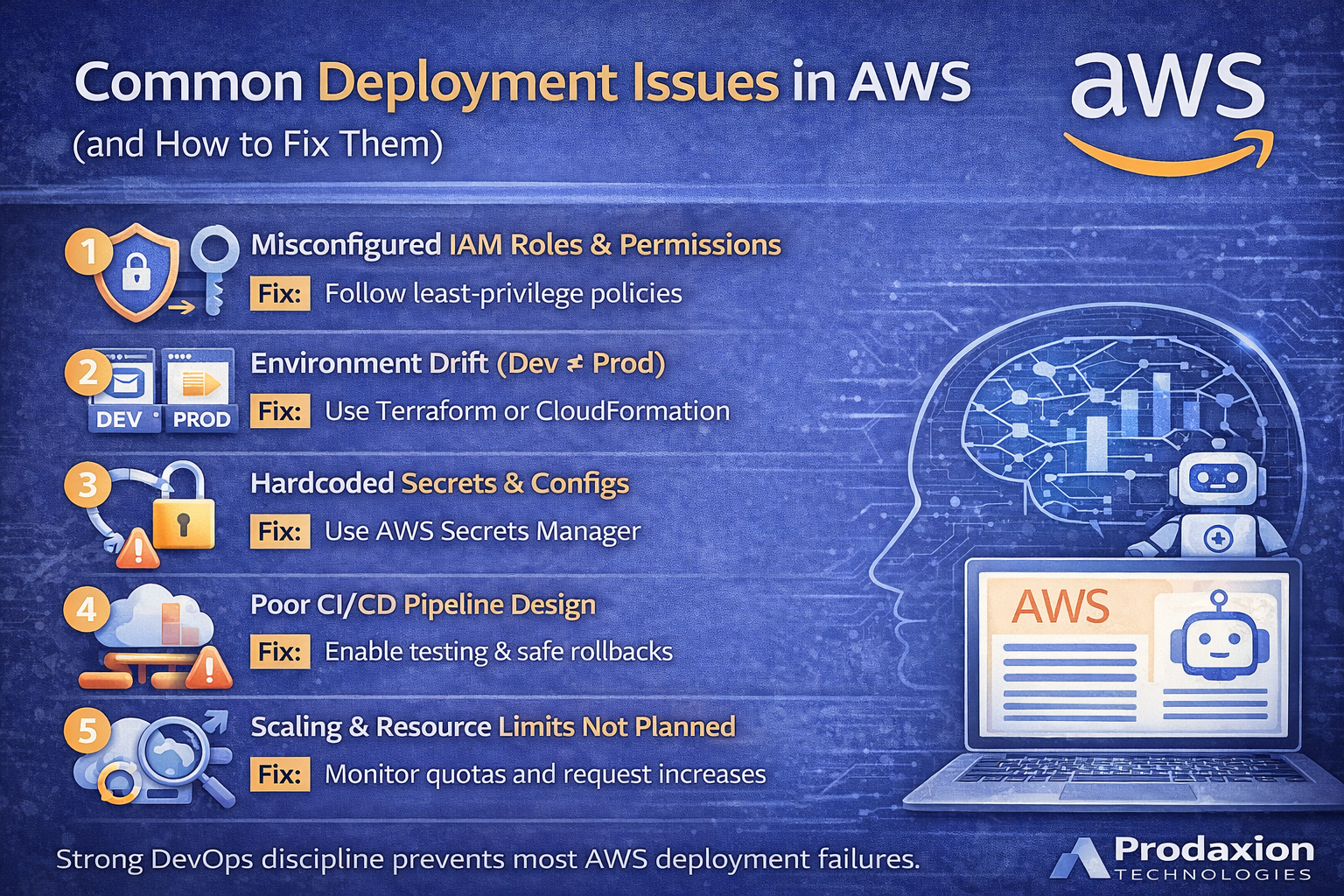
Amazon Web Services (AWS) powers millions of applications worldwide, from startups to global enterprises. While AWS offers scalability and flexibility, deployment issues are still one of the biggest causes of outages, downtime, and failed releases.
Many AWS deployment failures are not caused by AWS itself—but by configuration mistakes, process gaps, and missing automation.
In this guide, we’ll cover the most common AWS deployment issues and practical ways to fix them.
1. Misconfigured IAM Roles and Permissions
The Problem:
Incorrect IAM permissions are one of the top causes of failed deployments. Teams often use overly permissive roles or incorrect policies in CI/CD pipelines.
Common Issues:
-
Deployment pipelines failing due to missing permissions
-
Security risks from over-privileged roles
-
Runtime failures due to restricted service access
How to Fix It:
-
Follow the principle of least privilege
-
Separate roles for deployment, runtime, and administration
-
Use IAM policy testing and access analyzer tools
-
Audit IAM policies regularly
2. Environment Drift Between Dev, Staging, and Production
The Problem:
Code works in development but fails in production because environments are configured differently.
Common Causes:
-
Manual infrastructure changes
-
Different instance types, security groups, or environment variables
-
Missing infrastructure documentation
How to Fix It:
-
Use Infrastructure as Code (IaC) tools like Terraform or CloudFormation
-
Standardize environment configurations
-
Use containerization (Docker) for environment consistency
-
Automate environment provisioning
3. Hardcoded Secrets and Configuration Values
The Problem:
Hardcoding API keys, database passwords, or configuration values in code or pipelines can break deployments and cause security risks.
Risks:
-
Secrets leaks in Git repositories
-
Broken deployments when values change
-
Compliance and security violations
How to Fix It:
-
Use AWS Secrets Manager or SSM Parameter Store
-
Integrate secrets into CI/CD securely
-
Rotate credentials regularly
-
Avoid storing secrets in code or images
4. Weak CI/CD Pipeline Design
The Problem:
Manual deployments and poorly designed pipelines increase the risk of downtime and human errors.
Common Pipeline Issues:
-
No automated tests
-
No rollback strategy
-
Manual approvals for critical steps
-
Single-point deployment failures
How to Fix It:
-
Implement automated testing (unit, integration, smoke tests)
-
Use blue-green or canary deployments
-
Add automatic rollback mechanisms
-
Monitor pipeline health and logs
5. Scaling Limits and Quotas Not Planned
The Problem:
AWS has service limits (EC2 instances, Lambda concurrency, API Gateway requests). Deployments can fail when these limits are reached.
Common Scenarios:
-
Traffic spikes causing deployment failures
-
New environments failing due to quota limits
-
Scaling delays during product launches
How to Fix It:
-
Monitor AWS service quotas
-
Request limit increases early
-
Implement auto-scaling policies
-
Use load testing before major releases
6. Missing Monitoring and Logging
The Problem:
Deployments fail silently without proper monitoring and logging, making debugging difficult.
Common Issues:
-
No CloudWatch alerts
-
Lack of structured logs
-
No dashboards for deployment health
How to Fix It:
-
Enable AWS CloudWatch metrics, logs, and alarms
-
Implement centralized logging (ELK, Datadog, OpenSearch)
-
Create dashboards for deployment metrics
-
Use alerts for failures and anomalies
7. Configuration Management Errors
The Problem:
Incorrect environment variables, configuration files, or parameter mismatches can break deployments.
Examples:
-
Wrong database endpoints
-
Incorrect feature flags
-
Missing environment variables
How to Fix It:
-
Use configuration management tools
-
Validate configs in CI/CD pipelines
-
Use templates and parameterized configs
-
Implement configuration versioning
Why AWS Deployment Issues Matter
Deployment failures lead to:
-
Application downtime
-
Lost revenue
-
Customer dissatisfaction
-
Security risks
-
Engineering productivity loss
For SaaS companies and startups, deployment reliability directly impacts business growth.
Best Practices for Reliable AWS Deployments
To minimize deployment issues:
-
Automate infrastructure and deployments
-
Use version control for infrastructure
-
Implement robust CI/CD pipelines
-
Monitor everything—metrics, logs, and alerts
-
Conduct regular deployment audits
-
Train teams on DevOps and cloud best practices
Final Thoughts
AWS is powerful, but deployments require discipline, automation, and observability. Most failures are preventable with strong DevOps processes and proactive monitoring.
Fixing deployment issues is not just a technical improvement—it’s a business reliability strategy.
If your team is struggling with AWS deployments, outages, or production reliability, Prodaxion Technologies can help.
We provide managed support, DevOps optimization, and production support services to keep your systems running smoothly. Visit us at www.prodaxion.com
Tags: AWS deployment issues,common AWS errors,DevOps deployment problems,AWS CI CD,cloud deployment best practices,AWS troubleshooting,production deployment issues,AWS monitoring and logging,cloud infrastructure automation,IAM misconfiguration,AWS scaling limits,Infrastructure as Code Terraform,AWS CloudFormation,cloud DevOps best practices,Prodaxion Technologies
Turn insights into action with Prodaxion’s expert application support and MSP solutions.
Turn insights into action with Prodaxion’s expert application support and MSP solutions.
Get reliable uptime, proactive monitoring, and performance-focused support tailored for modern businesses. Our specialists are ready to help you strengthen your systems and scale with confidence.