

Support Metrics That Actually Reflect Business Health
Support Metrics That Actually Reflect Business Health
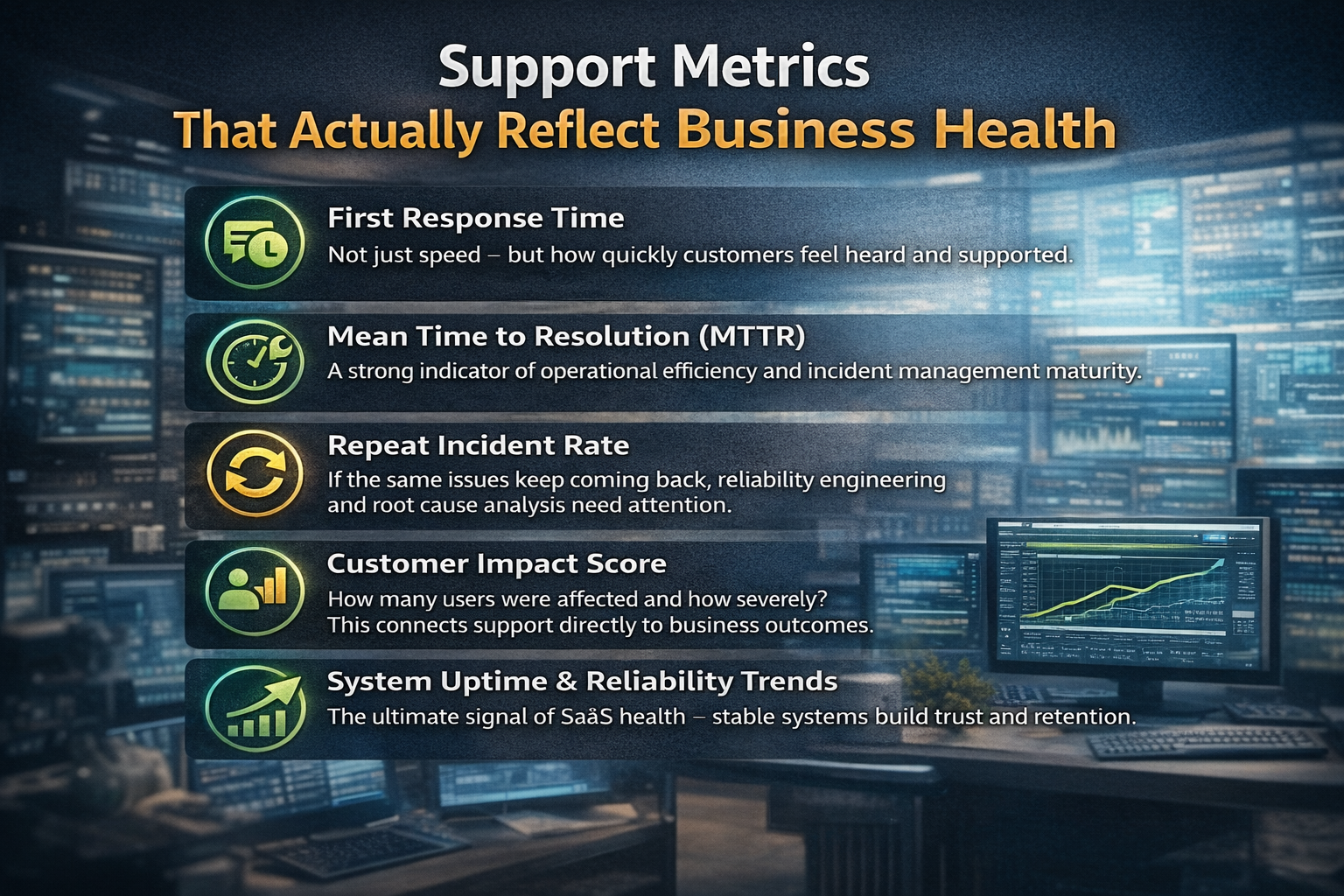
When businesses talk about customer support performance, the conversation often revolves around ticket volume, average response time, or how many issues were closed this week. While these numbers may look impressive on dashboards, they don’t always tell the real story about business health, customer satisfaction, or operational reliability.
Modern SaaS companies and digital businesses need smarter ways to measure support performance—metrics that reflect product stability, customer trust, and long-term growth. The right support metrics help leadership make better decisions, engineering teams improve reliability, and operations teams deliver consistent service.
Here’s a deeper look at which support metrics actually matter—and why they’re essential for scaling your business sustainably.
Why Traditional Support Metrics Can Be Misleading
Many organizations still rely on legacy KPIs such as:
-
Number of tickets closed
-
Average handle time
-
Support agent productivity
-
Volume of customer inquiries
While these metrics provide operational insights, they don’t always reflect:
-
Real customer experience
-
Product reliability
-
Service stability
-
Operational efficiency
For example, closing tickets quickly might look good on paper—but if customers keep reopening issues, the underlying product or process problem remains unresolved. That’s why modern managed services and application support teams are shifting toward metrics that measure long-term impact instead of short-term activity.
Support Metrics That Truly Reflect Business Health
1. Mean Time to Resolution (MTTR)
MTTR measures how quickly your team resolves incidents—not just acknowledges them. A lower MTTR indicates:
-
Efficient troubleshooting processes
-
Strong collaboration between support and engineering
-
Faster recovery from disruptions
For SaaS companies, improving MTTR directly impacts customer retention and operational uptime.
2. Incident Recurrence Rate
If the same problems keep happening, something deeper is broken. Tracking recurrence helps teams:
-
Identify root causes
-
Improve system reliability
-
Reduce long-term operational costs
This metric bridges the gap between reactive support and reliability engineering.
3. Customer Effort Score (CES)
Instead of only measuring satisfaction, CES evaluates how easy it is for customers to resolve issues. Lower effort typically leads to:
-
Higher loyalty
-
Fewer escalations
-
Better product usability
In many SaaS environments, reducing customer effort has a greater impact than reducing response time alone.
4. First Contact Resolution (FCR)
FCR measures how often issues are solved in a single interaction. High FCR rates indicate:
-
Strong documentation and knowledge bases
-
Skilled support engineers
-
Effective internal processes
It also reduces operational load and improves customer trust.
5. Service Reliability and Uptime Impact
Support teams play a crucial role in monitoring and maintaining uptime. Tracking how incidents affect:
-
System availability
-
Performance degradation
-
Customer-facing functionality
helps organizations align support metrics with real business outcomes.
6. Escalation Trends
Frequent escalations often signal deeper operational challenges, such as:
-
Lack of documentation
-
Product design issues
-
Insufficient training
Monitoring escalation patterns provides insights into both support effectiveness and product maturity.
How Managed Services Improve Support Metrics
Businesses that adopt managed application support and production support services often see measurable improvements in operational KPIs. A mature support partner focuses on:
-
Proactive monitoring and incident prevention
-
Structured incident management workflows
-
Root cause analysis and continuous improvement
-
Collaboration between DevOps, QA, and support teams
Instead of reacting to problems after they occur, managed services help organizations maintain stability and predictability.
Aligning Support Metrics With Business Strategy
Support metrics shouldn’t exist in isolation—they should connect directly to business objectives such as:
-
Customer retention and satisfaction
-
Operational efficiency
-
Product reliability
-
Revenue growth
When leadership teams analyze support performance through this broader lens, support shifts from a cost center to a strategic growth function.
The Future of Support Metrics
As businesses scale and technology stacks grow more complex, support teams are evolving into reliability-focused operations groups. The future of support metrics includes:
-
Predictive analytics for incident prevention
-
Automated monitoring and alerts
-
Integration with DevOps and reliability engineering
-
Data-driven performance optimization
Organizations that embrace modern support metrics gain a clearer understanding of how operational performance impacts customer success and long-term business health.
Final Thoughts
The most valuable support metrics aren’t the ones that show how busy your team is—they’re the ones that demonstrate stability, reliability, and customer impact. By focusing on MTTR, recurrence rates, customer effort, and uptime impact, businesses can build stronger operational foundations and deliver consistently reliable service.
If your organization wants to move beyond reactive ticket handling and toward proactive reliability, evaluating the right support metrics is the first step.
👉 Learn how proactive application support and managed services can strengthen your operational performance and customer experience: www.prodaxion.com
Tags: support metrics,business health metrics,customer support KPIs,managed services support,application support services,production support,IT operations metrics,SaaS support performance,incident management KPIs,service reliability metrics,customer experience metrics,DevOps support,technical support performance,operational efficiency metrics,proactive IT support
Turn insights into action with Prodaxion’s expert application support and MSP solutions.
Turn insights into action with Prodaxion’s expert application support and MSP solutions.
Get reliable uptime, proactive monitoring, and performance-focused support tailored for modern businesses. Our specialists are ready to help you strengthen your systems and scale with confidence.