

How Much Application Support Does a Small Business Actually Need?
How Much Application Support Does a Small Business Actually Need?
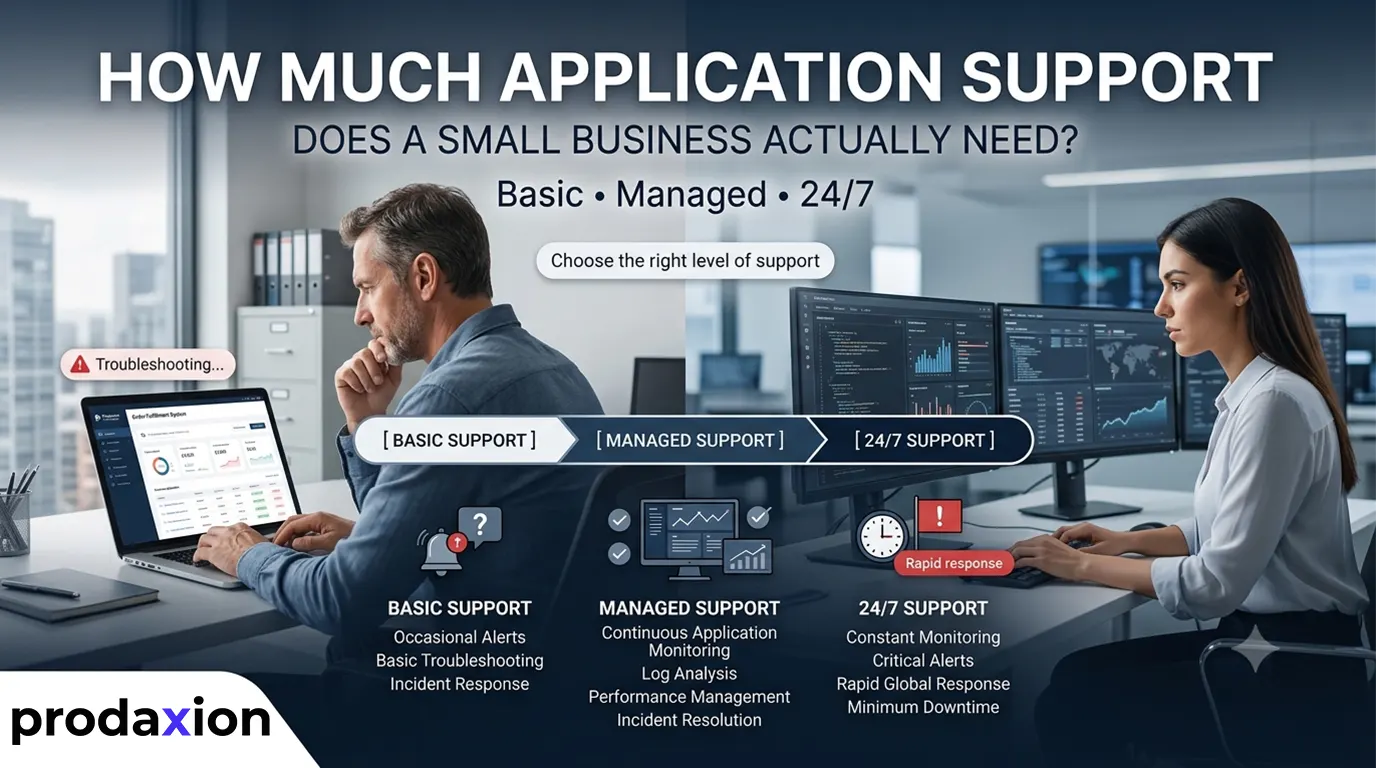
Small businesses often assume that application support is an all-or-nothing decision.
Either the team handles everything internally, or the business needs an expensive 24/7 IT support contract.
In reality, there is a middle ground.
The right amount of application support for a small business depends on how important its applications are, how frequently problems occur, how quickly issues need to be resolved, and what the business can realistically afford.
The most important question isn’t:
“Do we need application support?”
It is:
“How much application support does our business actually need?”
What Is Application Support?
Application support is the ongoing technical support required to keep a business application available, reliable, and functioning properly.
Depending on the business and application, application support can include:
~ Monitoring applications
~ Troubleshooting production issues
~ Investigating application errors
~ Reviewing logs
~ Responding to incidents
~ Supporting deployments
~ Investigating performance problems
~ Troubleshooting database issues
~ Managing escalations
~ Performing root-cause analysis
~ Identifying recurring problems
~ Supporting application availability
Not every business needs all of these services at the same level.
That’s why determining the appropriate support model is important.
Why Small Businesses Often Underestimate Application Support
When a company is small, application support can seem unnecessary.
The founder might think:
“Our developer can handle it.”
And initially, that may work.
The application has relatively few users, the team knows the system well, and production incidents may be rare.
But as the business grows, the situation can change.
The same developer may now be responsible for:
~ Building new features
~ Fixing bugs
~ Deploying releases
~ Responding to customers
~ Monitoring production
~ Investigating incidents
~ Managing cloud infrastructure
Eventually, production support begins competing with product development.
Instead of building the next feature, developers are spending their morning investigating why an application stopped responding at 2:00 AM.
That’s when businesses should start thinking about a more structured application support model.
The First Question: How Critical Is Your Application?
The most important factor is business impact.
Not every application deserves the same level of support.
Consider three different businesses.
Business A: Internal Administrative Application
The application is used by five employees to manage internal documents.
If it is unavailable for several hours, employees can temporarily use another process.
The business may only need basic support during normal business hours.
Business B: Core Business Application
The application manages customer orders and internal operations.
If it goes down, employees cannot process orders.
The business may need regular monitoring and relatively quick incident response.
Business C: Customer-Facing SaaS Platform
The application is the company’s primary product.
Customers expect it to be available at all times.
A significant outage could result in:
~ Lost revenue
~ Customer complaints
~ SLA problems
~ Reputation damage
~ Customer churn
This type of business may need a much more structured support model, potentially including 24/7 monitoring and incident response.
Three Common Levels of Application Support
For many SMBs, application support can be thought of in three broad levels.
Level 1: Basic Application Support
This is suitable for applications that are important but don’t require constant attention.
Basic support might include:
~ Business-hours troubleshooting
~ Incident response
~ Application error investigation
~ Basic log analysis
~ Deployment assistance
~ Escalation when necessary
This can be a good starting point for a small business with relatively few incidents.
Who might need it?
~ Small businesses
~ Internal applications
~ Low-traffic websites
~ Early-stage startups
~ Non-critical business systems
The goal is simple:
Have someone available when something goes wrong.
Level 2: Managed Application Support
As an application becomes more important, simply waiting for someone to report an issue may not be enough.
A managed application support model can introduce more proactive processes.
This can include:
~ Application monitoring
~ Regular alert review
~ Production incident management
~ Log analysis
~ Performance monitoring
~ Deployment support
~ Recurring issue analysis
~ Root-cause analysis
~ Operational reporting
Instead of waiting for users to complain, the support team can monitor the application and identify potential issues earlier.
This can help reduce the amount of time an application remains unavailable or degraded.
Who might need managed application support?
~ Growing SaaS businesses
~ E-commerce companies
~ Businesses with customer-facing applications
~ Companies with frequent deployments
~ Businesses without dedicated application support engineers
~ SMBs whose developers are spending too much time on production issues
For many growing businesses, this can be the sweet spot between doing everything internally and paying for a large 24/7 support operation.
Level 3: 24/7 Application Support
Some applications simply cannot wait until the next business morning.
If an application generates revenue around the clock or supports critical customer operations, downtime can become expensive very quickly.
In these cases, businesses may need:
~ 24/7 monitoring
~ Critical incident response
~ On-call support
~ Escalation procedures
~ Production monitoring
~ Application health checks
~ Rapid troubleshooting
~ Incident communication
~ Root-cause analysis
The important thing to understand is that 24/7 support doesn’t necessarily mean having a large team working around the clock.
A properly designed support model can use monitoring, alerting, escalation procedures, on-call rotations, automation and defined response processes.
How Much Downtime Can Your Business Afford?
This is one of the best questions a business owner can ask.
Imagine your application generates $2,000 in revenue every day.
If it goes offline for eight hours, the potential financial impact may be significant.
Now imagine an internal application that doesn’t directly generate revenue.
The cost of an eight-hour outage may be much smaller.
Therefore, your support investment should be related to the business impact of downtime.
Ask:
What happens if the application is unavailable for one hour?
What happens if it is unavailable for eight hours?
What happens if it goes down overnight?
What happens if it fails on a weekend?
The answers can help determine the appropriate support level.
Don’t Forget About Performance Problems
Application support isn’t only about outages.
An application can be technically “up” while still causing serious problems.
For example:
~ Pages take 10 seconds to load
~ Customers experience timeouts
~ API requests are slow
~ Database queries take too long
~ Background jobs are delayed
~ Employees experience application freezes
These problems can gradually affect productivity and customer satisfaction.
Application performance monitoring can help businesses identify these issues before they become major incidents.
Monitoring Doesn’t Replace Application Support
Many businesses install monitoring tools and assume the problem is solved.
Monitoring is important.
But a dashboard doesn’t fix an incident.
Imagine your monitoring system sends an alert at 2:00 AM:
Database connection failures detected.
Someone still needs to:
- Investigate the alert.
- Determine what caused it.
- Assess business impact.
- Take corrective action.
- Restore the application.
- Determine whether the problem could happen again.
- Document the incident.
This is where application support services become valuable.
Monitoring provides visibility.
Support provides the people, process and technical response behind that visibility.
Why Developers Shouldn’t Always Be the First Line of Production Support
Developers are often the first people small businesses rely on when something breaks.
That makes sense initially.
They built the application, so they understand it.
But there is a hidden cost.
Every production incident takes developers away from planned development work.
For example, a developer might have planned to spend the day working on:
New customer features
Instead, they spend six hours investigating:
A recurring production error
The business is effectively paying development rates for operational support.
As the number of incidents increases, product development slows.
A dedicated or outsourced application support function can allow developers to spend more time on development while support engineers focus on keeping production systems running.
How Much Application Support Does a Startup Need?
Startups should avoid overengineering their support model too early.
An early-stage startup may not need a full 24/7 support operation.
Instead, it may begin with:
~ Business-hours support
~ Basic monitoring
~ Documented incident procedures
~ Log access
~ Deployment procedures
~ Defined escalation paths
As the customer base grows, the support model can evolve.
For example:
Stage 1: Developer handles production issues.
Stage 2: Developer + outsourced application support.
Stage 3: Managed application support with monitoring and incident management.
Stage 4: Extended or 24/7 support for business-critical systems.
The support model should grow with the business.
How Much Application Support Does an E-Commerce Business Need?
E-commerce businesses have a different risk profile.
If customers cannot:
~ Browse products
~ Add items to a cart
~ Complete checkout
~ Make payments
~ Receive order confirmations
the business may immediately lose revenue.
For this reason, e-commerce businesses may benefit from more proactive monitoring and faster incident response than businesses using applications purely for internal administration.
However, the exact support level depends on:
~ Revenue volume
~ Operating hours
~ Customer expectations
~ Application complexity
~ Number of users
~ Cost of downtime
What About SaaS Businesses?
For a SaaS company, the application is often the product.
This makes application reliability particularly important.
A SaaS company may need support for:
~ Application availability
~ APIs
~ Databases
~ Cloud infrastructure
~ Deployments
~ Background jobs
~ Authentication
~ Integrations
~ Performance
~ Production incidents
As the customer base grows, even a relatively small technical issue can affect many customers simultaneously.
This makes structured application support increasingly valuable.
How to Decide What Level of Support You Need
You don’t need to guess.
Start by evaluating your business across several areas.
1. Application Criticality
How important is the application to daily operations?
Low: Work can continue without it.
Medium: Productivity is affected.
High: Revenue or critical operations stop.
2. Number of Users
How many people depend on the application?
Five internal users and 50,000 customers represent very different support requirements.
3. Downtime Cost
Estimate what one hour of downtime costs your business.
Consider both direct and indirect costs.
4. Incident Frequency
How often do application problems occur?
If you experience one minor incident every few months, basic support may be enough.
If production incidents happen every week, you may need a more structured approach.
5. Internal Expertise
Do you already have:
~ Application support engineers?
~ DevOps engineers?
~ Cloud engineers?
~ Database expertise?
~ On-call coverage?
If not, outsourcing may make sense.
6. Deployment Frequency
Businesses deploying software several times per day generally need a stronger operational support process than businesses deploying once every six months.
A Simple Application Support Assessment
You can use the following questions as a starting point.
| Question | Low Need | Higher Need |
|---|---|---|
| Application criticality | Internal | Revenue-generating |
| Users | Few | Many |
| Downtime impact | Minimal | Significant |
| Incidents | Rare | Frequent |
| Deployments | Occasional | Frequent |
| Monitoring | Basic | Continuous |
| Internal support | Available | Limited |
| Customer impact | Low | High |
| Required response | Next business day | Rapid/24×7 |
The more your business falls into the right-hand column, the more structured your application support model may need to become.
Outsourcing Application Support Can Be a Middle Ground
Small businesses sometimes assume the only alternatives are:
Hire internally
or
Do it ourselves.
Outsourcing provides another option.
An application support provider can provide technical resources without requiring the business to hire a complete internal team.
This can be particularly useful when the business:
~ Has a small development team
~ Has limited IT staff
~ Needs occasional production support
~ Needs monitoring expertise
~ Wants to reduce developer interruptions
~ Is growing faster than its internal operations team
The business can essentially access specialized support when it needs it.
What Prodaxion Technologies Provides
At Prodaxion Technologies, we focus on application and production support for small and medium-sized businesses.
Our objective is not to convince every business that it needs 24/7 support.
Instead, we believe support should be matched to the actual needs and risk profile of the application.
Our application support services can include:
~ Application monitoring
~ Production support
~ Incident management
~ Log and error analysis
~ Deployment support
~ Performance troubleshooting
~ Application issue investigation
~ Root-cause analysis
~ Operational support
For some businesses, basic support may be enough.
For others, managed support may provide better value.
For business-critical applications, extended or 24/7 support may be appropriate.
The important thing is to choose a support model based on business impact rather than simply choosing the biggest package available.
Application Support Should Scale With Your Business
One of the biggest advantages of an outsourced application support model is flexibility.
A business doesn’t necessarily need to jump from:
No support → 24/7 support
overnight.
Instead, it can gradually increase its support maturity.
Early stage
Basic monitoring and incident response.
Growing business
Managed application support and proactive monitoring.
Established business
Structured incident management, performance monitoring and root-cause analysis.
Business-critical application
Extended or 24/7 monitoring and response.
This approach can help businesses avoid both under-supporting critical applications and overpaying for unnecessary services.
Frequently Asked Questions
Does every small business need application support?
No. The appropriate level depends on the importance of the applications, number of users, incident frequency, internal expertise and cost of downtime.
Is 24/7 application support necessary for every business?
No. Businesses with non-critical internal applications may only need business-hours support. Customer-facing or revenue-critical applications may require faster or continuous support.
Should developers handle application support?
Developers can handle production support, particularly in early-stage businesses. However, as the company grows, frequent production issues can take developers away from product development.
What is managed application support?
Managed application support is an ongoing support model that can include monitoring, incident management, troubleshooting, log analysis, performance monitoring, deployment support and root-cause analysis.
Is outsourced application support suitable for SMBs?
Yes. Outsourcing can give SMBs access to application support expertise without requiring them to hire and maintain a full internal support team.
How much does application support cost?
The cost depends on factors such as application complexity, support hours, number of applications, monitoring requirements, response times and whether 24/7 coverage is required. Businesses should choose a support model based on their actual operational needs.
Final Thoughts
There is no magic number for how much application support a small business needs.
The right answer depends on one fundamental question:
What happens to your business when your application doesn’t work?
If the impact is minimal, basic support may be enough.
If your team depends heavily on the application, managed support may provide better reliability and reduce the burden on internal employees.
If the application directly generates revenue or supports customers around the clock, 24/7 monitoring and incident response may be worth the investment.
The goal isn’t to buy the most support.
The goal is to have enough support to protect the business without unnecessarily increasing costs.
If your developers are spending too much time dealing with production issues, or your business doesn’t have anyone responsible for application reliability, it may be time to evaluate your current support model.
Talk to Prodaxion Technologies About Application Support
The right application support model should grow with your business—not ahead of it.
Turn insights into action with Prodaxion’s expert application support and MSP solutions.
Turn insights into action with Prodaxion’s expert application support and MSP solutions.
Get reliable uptime, proactive monitoring, and performance-focused support tailored for modern businesses. Our specialists are ready to help you strengthen your systems and scale with confidence.