

How to Choose an Application Support Provider for a Small Business
How to Choose an Application Support Provider for a Small Business
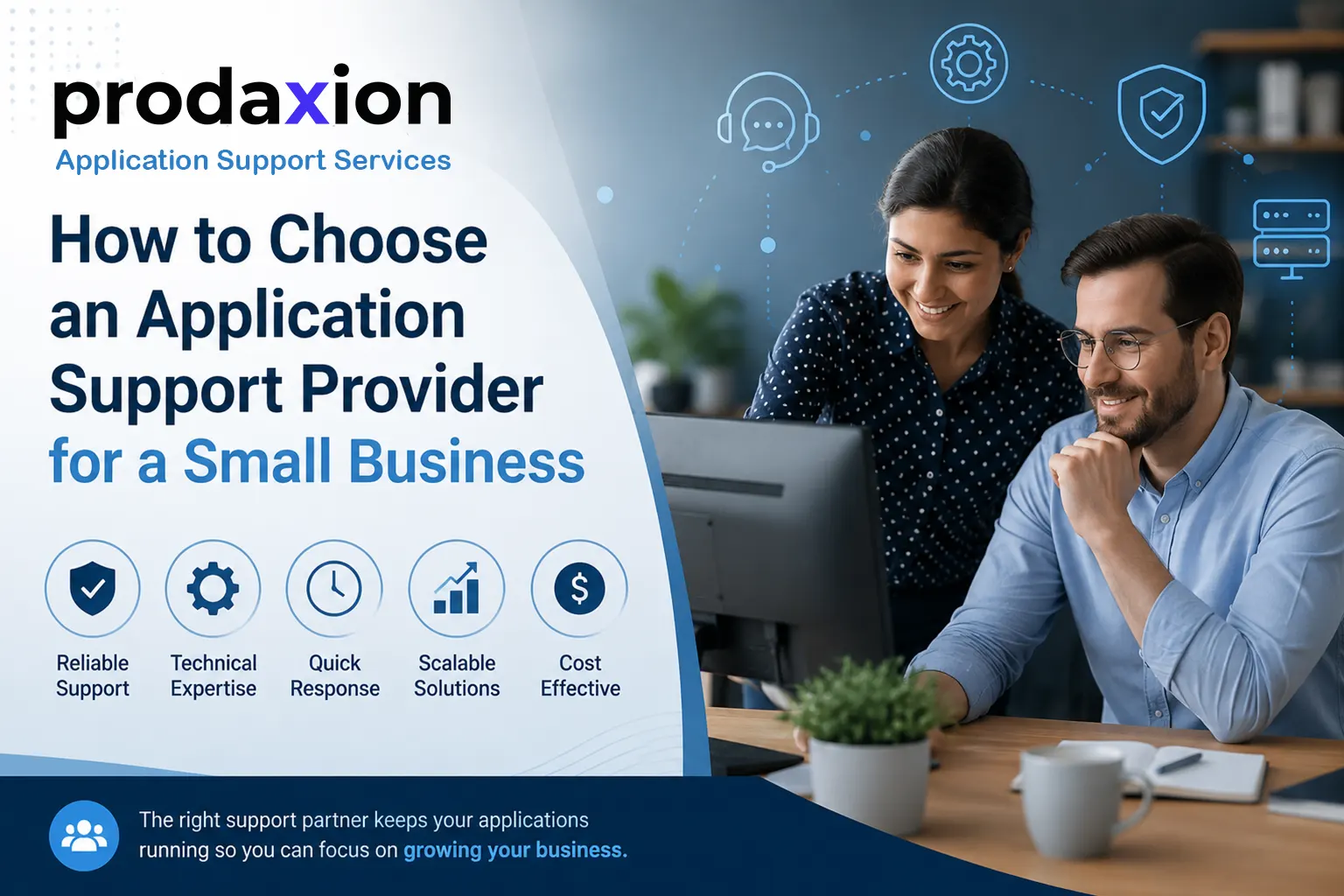
For a small business, choosing an application support provider is an important decision. Your application may support daily operations, customer service, sales, payments, reporting, or other critical business functions.
When something goes wrong, you need more than someone who simply responds to a ticket. You need a support partner who understands your application, can investigate production issues, communicates clearly, and provides the level of support your business actually needs.
At the same time, a small business may not have the budget or workload to justify hiring a dedicated application support team or signing an expensive enterprise MSP contract.
So, how do you choose the right application support provider for your small business?
1. Make Sure They Understand Your Application
Application support is different from general IT support.
A provider should be able to understand the application’s:
~ Technology stack
~ Architecture
~ Database
~ APIs and integrations
~ Cloud environment
~ Deployment process
~ External dependencies
~ Critical business functions
The better the provider understands your application, the faster they can investigate problems when something goes wrong.
You should also ask how the provider will learn your environment before taking responsibility for production support.
2. Look at the Support Coverage You Actually Need
Not every small business needs 24/7 application support.
If your application is primarily used during business hours, standard support coverage may be sufficient.
Other businesses may need:
~ Extended business-hours support
~ Weekend support
~ After-hours incident response
~ 24/7 monitoring
~ 24/7 incident support
The important thing is to match support coverage to your business requirements.
Paying for services you don’t need can make application support unnecessarily expensive.
3. Understand the SLA
Before signing an agreement, understand the provider’s application support SLA.
The SLA should clearly explain expectations around:
~ Response times
~ Incident severity
~ Escalation procedures
~ Support hours
~ Communication
~ Resolution targets
~ Service availability
For example, a critical production outage should not necessarily receive the same response as a minor application issue.
A clear SLA gives both the business and the support provider a common understanding of what happens when an incident occurs.
4. Ask How They Handle Production Incidents
This is one of the most important questions to ask an application support company.
When your application stops working, what happens?
A good provider should have a structured approach to:
- Identify the incident
- Assess the impact
- Investigate the problem
- Restore service
- Communicate with stakeholders
- Identify the root cause
- Document the incident
- Recommend preventive action where appropriate
The goal isn’t simply to make the error disappear.
The goal is to understand why it happened and whether it is likely to happen again.
5. Don’t Look Only at Monitoring
Monitoring is valuable, but monitoring alone isn’t application support.
Dashboards and alerts can tell you that something is wrong. Someone still needs to investigate the problem.
Ask whether the provider can work with:
~ Application logs
~ Infrastructure logs
~ Error messages
~ Database information
~ Performance data
~ Deployment history
~ API failures
~ Cloud monitoring
A support provider should be able to turn monitoring information into practical troubleshooting and action.
6. Find Out Who Will Actually Support Your Application
This is particularly important for small businesses.
Ask:
Who will actually work on our application when we have a problem?
Will you have:
~ A dedicated support engineer?
~ A shared support team?
~ A named technical contact?
~ Different engineers depending on the incident?
~ A help desk that escalates technical problems elsewhere?
Understanding the support structure can help you determine whether the service is appropriate for your business.
7. Consider Their Cloud and Deployment Experience
Modern applications often depend on cloud infrastructure and automated deployment processes.
If your application runs on AWS, Azure, or another cloud platform, your support provider should understand the environment sufficiently to investigate application-related production issues.
This can include:
~ Deployment failures
~ Configuration problems
~ Application errors after releases
~ Database connectivity
~ API failures
~ Resource issues
~ Logging and monitoring
~ Environment differences
You don’t necessarily need a provider that manages your entire cloud infrastructure.
But they should understand the parts of the environment that affect your application.
8. Make Sure Communication Is Simple
Small businesses don’t want to spend hours explaining technical problems to multiple departments.
Your application support provider should make communication straightforward.
You should know:
Who do I contact?
How do I report an incident?
How will I know what’s happening?
Who tells me when the issue is resolved?
Good technical support also means explaining technical problems in a way that business owners and non-technical employees can understand.
9. Look for Documentation and Knowledge Transfer
Application knowledge shouldn’t exist only inside one support engineer’s head.
A good support process should gradually build useful documentation covering things such as:
~ Application architecture
~ Common incidents
~ Troubleshooting procedures
~ Deployment information
~ Important integrations
~ Known problems
~ Escalation procedures
~ Recovery procedures
Good documentation makes support more consistent and reduces dependency on individual people.
10. Consider Whether You Need a Large MSP
A large managed service provider can be appropriate for some businesses.
But a small business doesn’t necessarily need a provider that manages every aspect of its IT environment.
You may simply need someone to take responsibility for application and production support.
For example, your business may already have:
~ Microsoft 365 managed elsewhere
~ Hardware managed by an IT company
~ Internet and networking managed by another provider
~ Cloud infrastructure managed internally
But your business application may still need dedicated technical support.
In that situation, a specialized application support provider may be more appropriate than purchasing a large, all-inclusive MSP service.
11. Understand What Is Included in the Price
Don’t compare providers based only on the monthly price.
Ask what the price actually includes.
For example:
~ Incident support
~ Monitoring
~ Troubleshooting
~ Log analysis
~ Deployment support
~ Application maintenance
~ Reporting
~ After-hours support
~ Cloud support
~ Emergency response
Two providers charging different prices may be offering very different services.
The better question is:
What am I actually getting for the price I’m paying?
12. Make Sure the Provider Can Scale With You
Your application support requirements may change as your business grows.
You might start with:
Business-hours support
and eventually need:
Extended coverage → 24/7 monitoring → 24/7 incident response
A good provider should be able to adjust the service as your requirements change rather than forcing you into a large package from day one.
In-House Support vs an Application Support Provider
For many small businesses, building an internal support team can be difficult.
Hiring even one experienced support engineer involves more than salary.
There are also costs associated with:
~ Recruitment
~ Benefits
~ Training
~ Vacation coverage
~ Sick leave
~ On-call coverage
~ Management
~ Knowledge retention
And one employee cannot realistically provide continuous coverage alone.
Outsourcing application support allows a business to access technical support without immediately building a complete internal team.
The right approach depends on the business, application, risk, budget, and support requirements.
Questions to Ask Before Choosing an Application Support Provider
Before signing an agreement, consider asking:
1. Have you supported applications similar to ours?
2. What technologies can your team support?
3. What are your response times for critical incidents?
4. What support hours are available?
5. Who will actually support our application?
6. How do you handle production incidents?
7. Do you provide monitoring and alerting?
8. How do you document incidents and solutions?
9. What is included in the monthly service?
10. Can the service scale as our business grows?
These questions can help you compare providers based on the things that actually matter to your business.
Application Support for Small and Medium-Sized Businesses
Small businesses don’t necessarily need the biggest MSP.
They need reliable support that fits their application and their business.
For some companies, the right solution may be an internal support engineer. For others, it may be a combination of internal development resources and an outsourced application support provider.
The important thing is to have clear ownership of the application and a reliable process for dealing with production problems.
How Prodaxion Supports Small Businesses
Prodaxion Technologies focuses on application and production support for small and medium-sized businesses that may not have the resources or need to maintain a dedicated application support team.
Our approach is designed around practical support rather than unnecessarily complex enterprise MSP arrangements.
We can help businesses with areas such as:
~ Application production support
~ Incident investigation
~ Application monitoring
~ Log and error analysis
~ Deployment support
~ Troubleshooting
~ Production issue management
~ Ongoing application support
The goal is simple: give small businesses access to dependable application support without requiring them to build a large internal support organization.
Final Thoughts
Choosing an application support provider should not come down to finding the cheapest monthly price.
Look at the provider’s technical capability, support coverage, SLA, incident management process, communication, documentation, monitoring, and ability to scale.
Most importantly, choose a support model that matches the actual needs and size of your business.
For an SMB, the right application support partner can provide the technical expertise and operational coverage you need—without the cost and complexity of building a large support team yourself.
If your business relies on a software application but maintaining an internal support team isn’t practical, outsourced application support may be worth considering.
Prodaxion works with small and medium-sized businesses that need dependable application and production support without the complexity of a large enterprise MSP.
Learn more about our application support services: www.prodaxion.com
#ApplicationSupport #ApplicationSupportServices #ApplicationSupportProvider #SmallBusinessIT #SMB #ManagedApplicationSupport #OutsourcedApplicationSupport #ProductionSupport #ITSupportServices #ManagedServices #SaaSSupport #SmallBusinessTechnology #BusinessApplicationSupport #Prodaxion
Turn insights into action with Prodaxion’s expert application support and MSP solutions.
Turn insights into action with Prodaxion’s expert application support and MSP solutions.
Get reliable uptime, proactive monitoring, and performance-focused support tailored for modern businesses. Our specialists are ready to help you strengthen your systems and scale with confidence.